General
Attracting International Patients: Why Check Google Maps Visibility Before Buying Ads?
At BlinkAd, we specialize in marketing to international customers. We start by diagnosing a business's current visibility. This article shares the results reported in one of our clinic assessments.
When a clinic asks about attracting international patients, the first question is often how much to spend on advertising. Before discussing that budget, we look at how the clinic appears when a prospective patient searches. That starting point helps us decide what to address first.
A Gangnam dermatology clinic: 25 locations, three keyword checks
The clinic in this case was near Dosan-daero in Gangnam. At the time, its Google rating was 5.0 out of 5. That was a positive review signal, rather than a measure of clinical outcomes. The assessment used a 5×5 grid of 25 search locations around the clinic and checked one Korean, one English and one Japanese keyword at each location: 75 keyword-location observations, not 75 different locations.
The original description gives an approximate 480-metre grid setting, without clearly distinguishing radius from spacing. We have not reconstructed those coordinates for this edition. The important point is that map rankings can vary by search location: a clinic may appear near its entrance but rank differently near a hotel a few blocks away. A grid shows more of that variation than a single search.
The reported results: Korean 0/25, English 4/25, Japanese 0/25
Each pin below represents a search location. Read the number on the pin: “20+” means the clinic was not found within the scan's top-20 limit. Colour alone does not tell you whether a result was inside that limit.
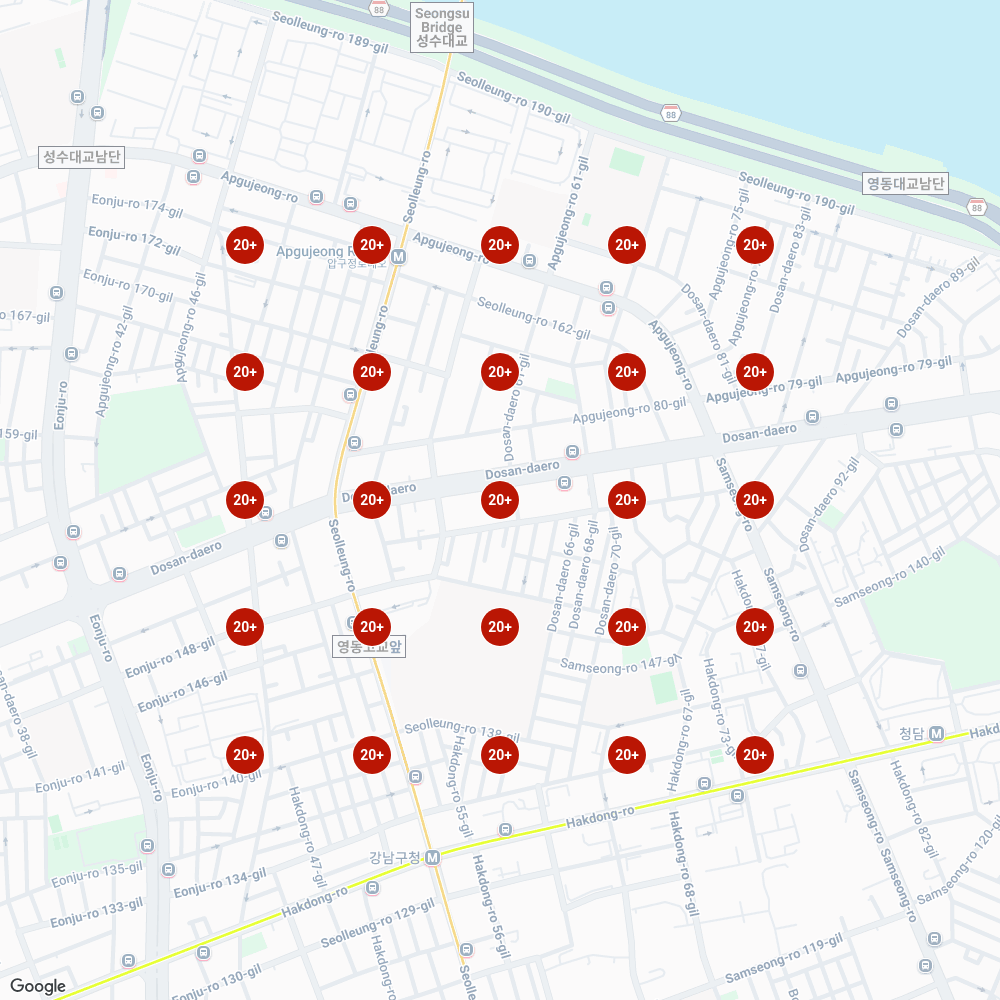
For 강남 피부과 (“Gangnam dermatology”), the article reported no top-20 result at any of the 25 locations, including the location at the clinic.
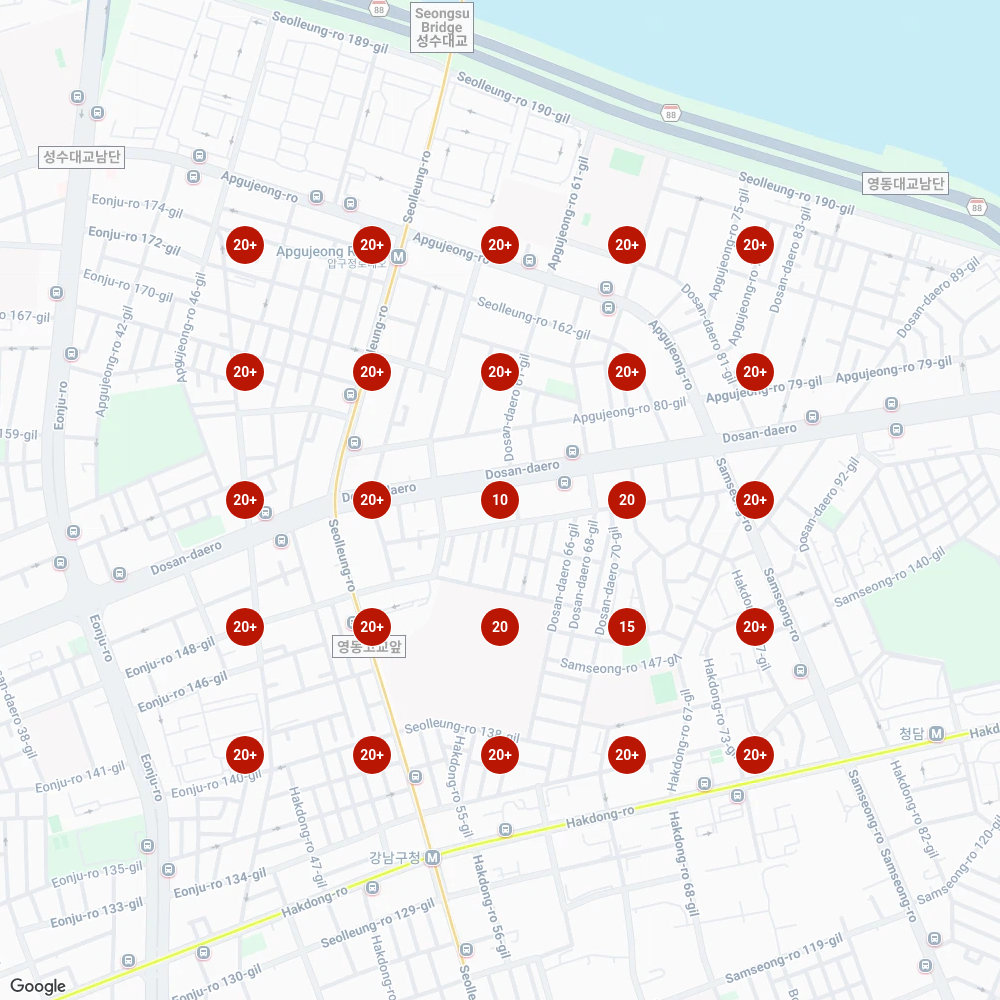
For gangnam dermatology, the clinic appeared within the top 20 at four locations. The visible ranks are 10, 20, 20 and 15, averaging 16.25, or about 16, across those four detected results. That is not an average across all 25 locations. None of the locations showed a top-three position.
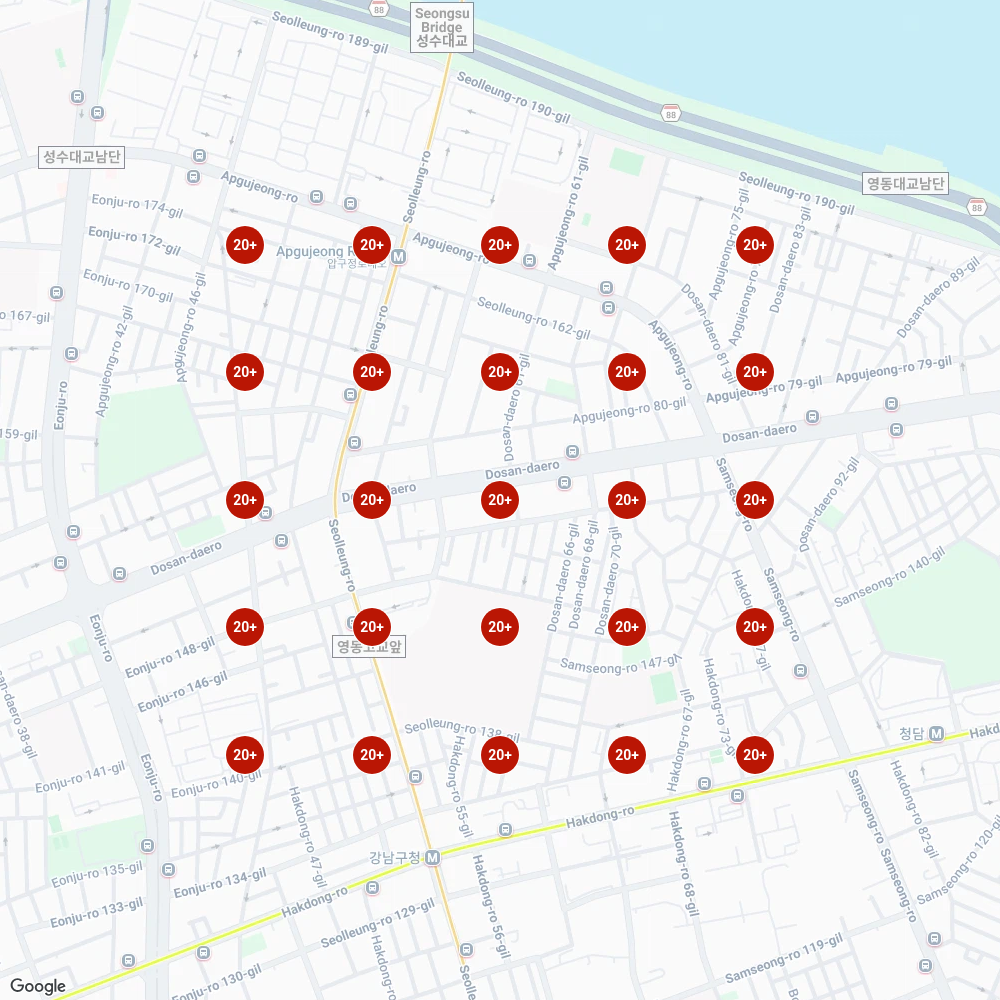
For the Japanese phrase 江南 皮膚科 (“Gangnam dermatology”), the article again reported no top-20 result across the grid. These results describe limited visibility for the selected keywords and locations at the recorded times. They do not mean that the clinic could never be found by name, on another platform or through another search.
Why did a 5.0 rating not translate into strong map visibility?
The clinic had seven Google reviews at the time. Some competitors ranking well for the Korean keyword had hundreds of reviews and ratings around 4.8–4.9. Google describes local results in terms of relevance, distance and prominence; review count and positive ratings can contribute. A high rating alone does not settle the ranking, and this comparison does not prove that review count caused the gap.
The source also described leading competitors with multilingual information on their profiles. It reported top-three visibility figures of 88% for the leading English-search competitor and 84% for the leading Japanese-search competitor. These are the original assessment's reported visibility metrics, not shares of patients, traffic or all available ranking positions. The full competitor reports are not reproduced here, so we have not recalculated those percentages.
Those observations make profile accuracy and useful language support worth checking. They do not prove that adding a language to a profile name improves rankings. A business name should reflect the real-world name used by the clinic, in line with Google's guidelines; unrelated keywords or invented name variations are not a remedy.
Why we diagnose visibility before planning ads
International patients may use Google, Maps or an AI service such as ChatGPT to research a clinic. The original article described map cards in some agency-observed AI answers showing business names and ratings. That is an observation of particular answers, not a universal account of where every AI service gets its information. Map visibility and AI mentions need to be checked separately.
Consider a patient who clicks an ad, then looks up the clinic on Maps before making an inquiry. They may compare its information and reviews with nearby alternatives. An incomplete or unconvincing profile can leave questions unanswered, even when the ad generated a click. This case does not measure wasted ad spend or prove that advertising would fail; it explains why we recommend diagnosis, basic improvements and then an advertising plan.
What a useful diagnosis should check
- The clinic's map positions for selected target-language keywords, measured across relevant locations rather than at one point.
- Which clinics appear in those results, and the differences in their accurate business information, review counts and language support.
- Whether selected AI services mention the clinic when asked relevant patient questions, with the language, date and conditions recorded.
- Whether prospective patients can understand the clinic's name, category, photographs and booking links.
These checks give the team a more concrete basis for setting priorities. In the case described here, profile information and a process for receiving genuine reviews deserved attention before increasing ad spend. A later comparison should use comparable keywords, locations and settings, record the new date and keep map positions separate from inquiries, bookings and visits.
How does your clinic appear today?
In a competitive area such as Gangnam, it helps to start with evidence. BlinkAd can assess how a clinic appears in searches relevant to international patients. If you would like to understand your current visibility, contact us about a diagnosis. We can discuss an appropriate grid and target-language queries for your clinic; an assessment does not guarantee a ranking or patient inquiries.
Related reading
- Why your clinic may be missing when a patient asks ChatGPT to recommend a Gangnam dentist
- Can AEO help dermatology and plastic surgery clinics reach international patients?
Evidence and dates: This is an English edition of the August 7, 2026 case article, preserving its existing images. The Korean-query image was captioned June 2026; the English and Japanese images were captioned August 7, 2026. They should not be treated as a simultaneous language experiment or a current ranking check. Original source screenshots may contain Korean map labels. We checked Google's local-ranking guidance and business representation guidelines on October 31, 2026. No new map scan, AI measurement or patient-outcome study was run for this edition.
BlinkAd is a Google and AI marketing agency helping businesses reach international customers through search, visits and inquiries.